The Stick-On Feet Planner
Each rubber foot sized for the heaviest corner and the floor under it, sized again for the glue that holds it when the item is pushed, the weakest layer found before it lets go, and grip dots counted inside the edge
RubberDot's free tools each answer one question, and a stick-on foot asks several at once. The Rubber Foot & Bumper Size Selector sizes a foot for the floor with the weight shared evenly. The Anti-Slip estimator shows how hard the floor grips it, and the Adhesive Bond calculator how hard the glue holds it. None of them says that when you push the item, the floor's grip on each foot is exactly the force trying to shear that foot off its glue. This planner puts the tools in order for one item. It sizes every foot for the heaviest one at a single working pressure (the site's two foot tools default to 300 and 500 kPa), rounds up to a standard size, turns the grip into the load on the glue, and sizes the foot again with the adhesive's lab figure divided by a safety factor of 3. In the worked example, a 12 kg printer heavier at the front: the selector says 13 mm feet, the front feet need 15 mm for the floor, and 30 mm for the glue with no bond figure on the pack, or 19 mm with a pad whose data sheet quotes 400 kPa. It adds a one-pad peel test for the weakest layer and counts grip dots that sit wholly inside the edge. Every figure is computed by the site's own calculators, three of which we fixed while writing it; the worked numbers are examples and the safety factor and friction range are called rules of thumb. It is not a load rating: anything load-bearing, overhead or on furniture that could tip is sent to the product's data sheet and professional advice, tall furniture to an anti-tip restraint, stairs to proper treads and a handrail, and small dots are flagged as a choking hazard for young children. Included: a 23-page printable PDF with seven steps, a foot plan, a grip dot layout, a fit and check log, a foot size reference table and a quickstart, plus a personalised sheet worked from the numbers you entered in the calculator.
Look inside
Two full pages from the planner, exactly as printed. Click either to read it at full size before you decide.
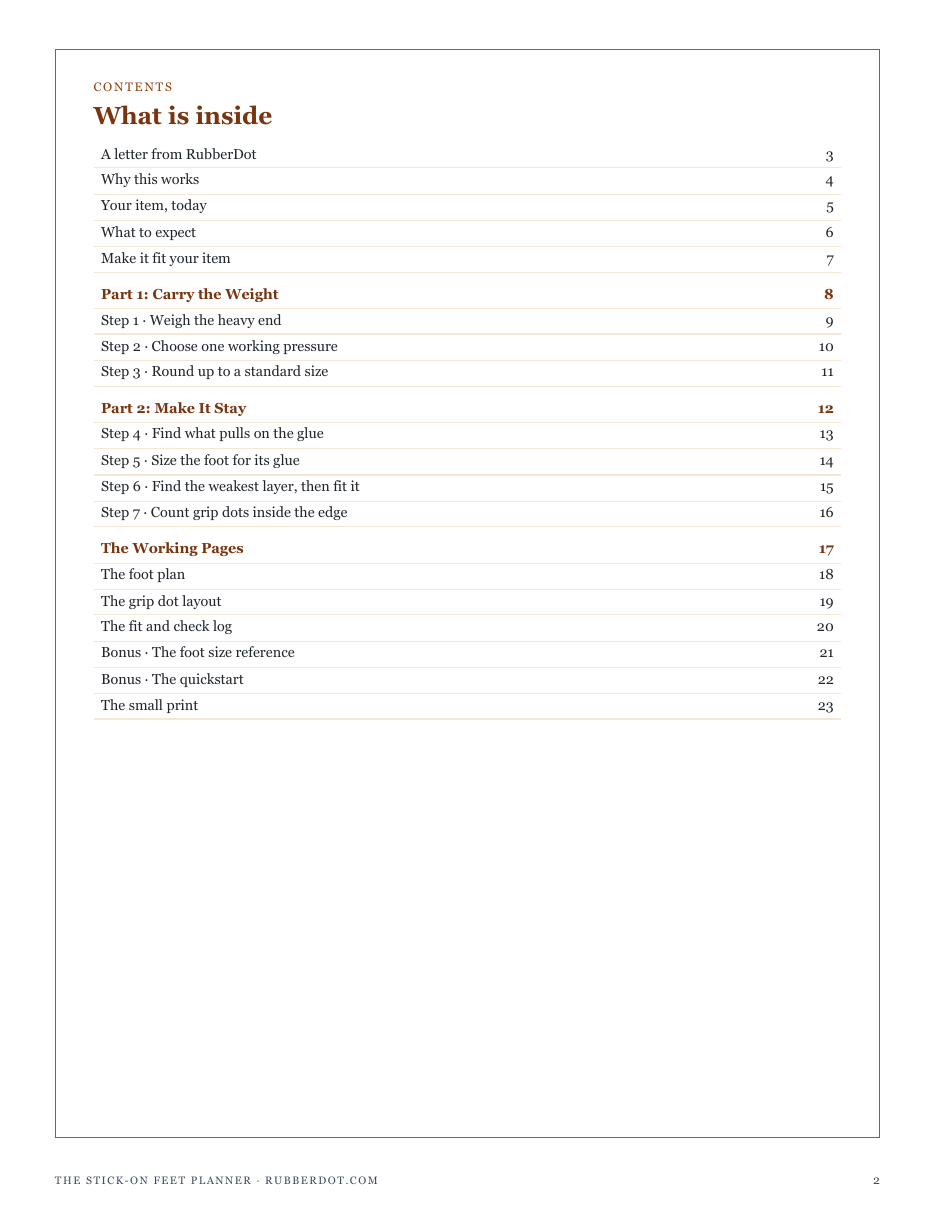
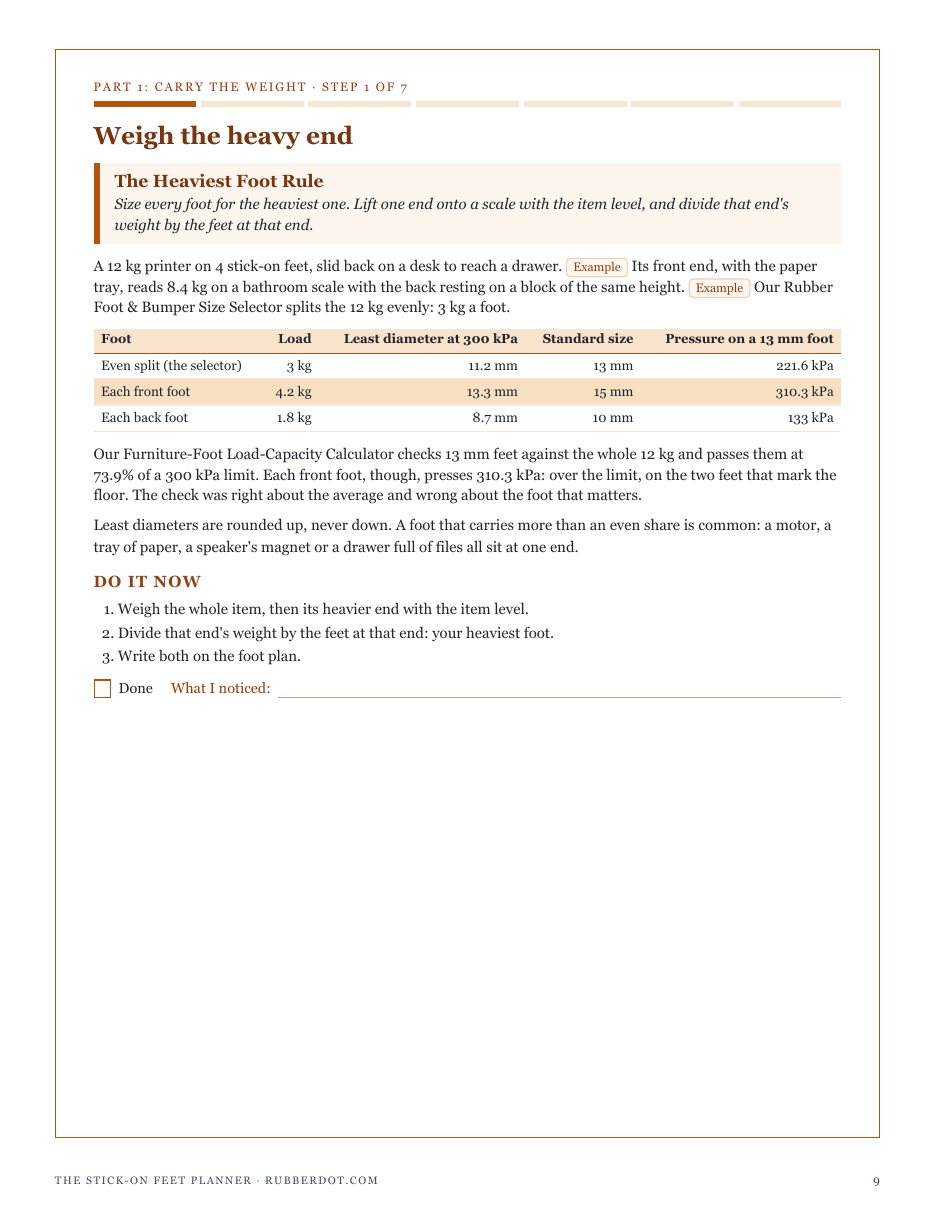
What is in it
- The Heaviest Foot Rule: weigh the heavy end, and size every foot for the heaviest one, not the even share
- The One Pressure Rule: size and check a foot with one working pressure, the softer of floor and foot
- The Round Up Rule: the next standard size up, measured across the flat face, and more feet past 50 mm
- Grip Loads the Glue: the floor's grip on each foot, as the load its adhesive carries
- The Working Load Rule: the adhesive's lab figure divided by 3, and the larger of the floor's size and the glue's
- The Weakest Layer Rule: a one-pad peel test, the fit, the one-day wait, and why feet do not stop a tip-over
- The Inside the Edge Rule: grip dots counted inside the edge, whole sheets, and the slip and small-parts cautions
- The foot plan, the grip dot layout, and the fit and check log (printable)
- The foot size reference: every standard foot's floor limit and glue limit, rounded down
- The quickstart, and a personalised sheet worked from your own calculator figures
- ✓ 23 printable pages
- ✓ 10 sections, worksheets and templates
- ✓ A second PDF worked out from the numbers you enter
- ✓ No account needed, just an email address
- ✓ Instant download; link valid 7 days
Price includes any taxes. Sold by GrabURL, who handle checkout and support. The charge appears on your statement as GrabURL.
The planner picks up where the free Rubber Foot & Bumper Size Selector leaves off. The selector sizes a foot for the floor with the weight shared evenly; the planner sizes it for the heaviest foot, checks it with the Furniture-Foot Load-Capacity Calculator at one working pressure, turns the floor's grip from the Anti-Slip Friction & Coefficient Estimator into the load on the glue, sizes the foot again for the Adhesive Bond Strength vs Load Calculator with a safety factor, and counts grip dots that sit inside the edge. The worked figures are examples. It is not a load rating: anything load-bearing, overhead, or on furniture that could tip belongs with the product's data sheet and professional advice. Small dots and bumpers are a choking hazard for young children.